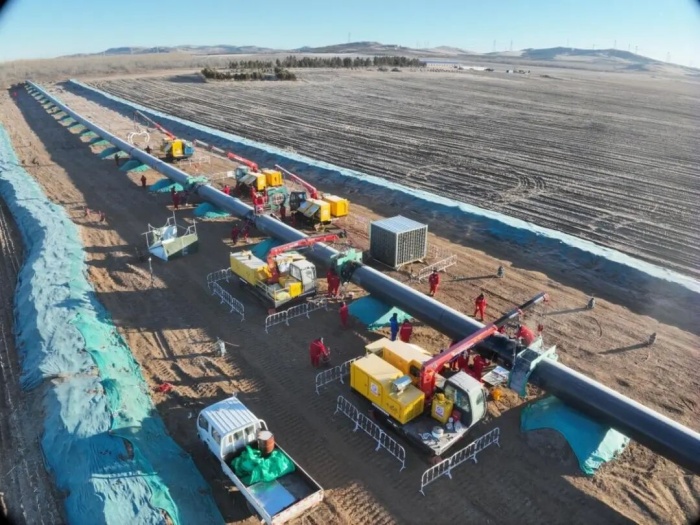
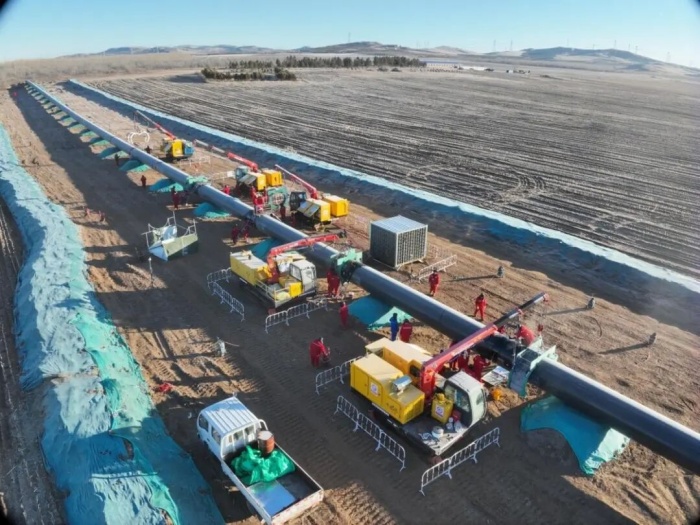
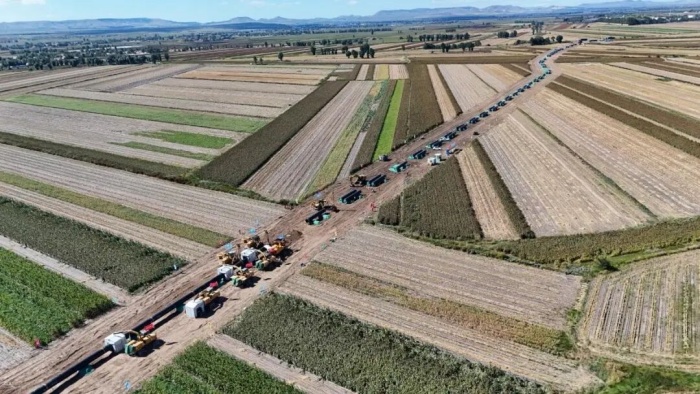
The Changling-Zhangjiakou section is over 1,100 kilometers long and covers 11 ecological sensitive areas along the way. Among them, the section passing through the Ulan Buoding grassland is approximately 16.84 kilometers long. The grassland has fragile ecological environment and a long natural vegetation recovery period, making it a key area for local ecological protection. This is also a "unavoidable crossing area" during the initial design stage of the Changchun-Shijiazhuang natural gas pipeline, where "both the construction of a national key project and the protection of the grassland's ecology are equally important." Zhang Tiancheng, the project manager of the Northern Project Management Center of the National Pipeline Network Group's Construction Project Management Company, said, "We strictly implemented the 'three simultaneously' principle for environmental protection and water conservation in the initial design stage. Every crossing plan was optimized through multiple surveys and optimizations to minimize the intervention on the grassland."
In the original design, the operation zone here was 35 meters wide. Zhang Tiancheng led the construction units to conduct repeated surveys and finally reduced it to 32 meters. A 3-meter-wide, nearly 17-kilometer-long section, which is not long on the 1,000-plus-kilometer project route, means less disturbance to the grassland.
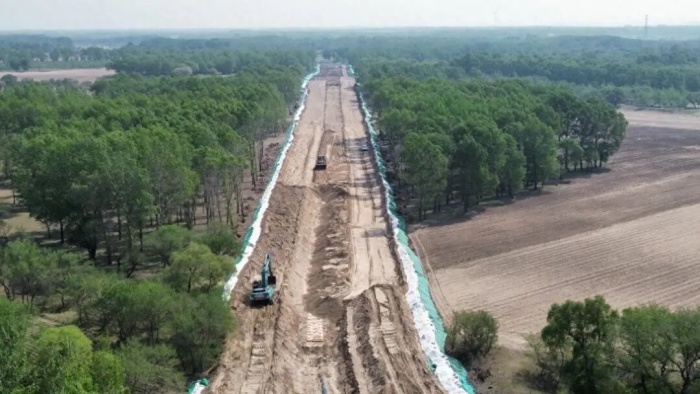
The topsoil layer is the most fertile soil on the grassland. If mixed with the deep soil, the fertility recovery will be affected. "In the past, when the pipeline was constructed, the excavators dug straight down, and the soil layers mixed together. Now, each layer of soil is separately stacked, and the protection of the land fertility becomes increasingly meticulous." The Chifeng Project Management Division transplanted the experience of protecting black soil to the grassland - strictly layer-by-layer excavation, layer-by-layer stacking, and in-situ backfilling. The topsoil is separately stripped, separately stacked, and during backfilling, the deep soil is filled first, and then the topsoil is restored. Construction wastewater, oil stains, and domestic sewage are all collected and disposed in compliance, and waste materials are classified and transported for clean removal, achieving "work completed, site cleaned up."
After the construction of the operation zone and temporary access roads is completed, restoration is carried out immediately. The project department selects suitable drought-resistant grass species for reseeding and greening, strictly preventing the invasion of alien species, and achieving "construction one section, restoration one section, and recovery one area." In the air, the drone becomes an "ecological sentinel," conducting "randomized dual" aerial inspections. The aerial panoramic survey and ground synchronous verification form a three-dimensional supervision system of "high-altitude overview + ground verification," making environmental control more precise and efficient. The reduction of the 3-meter operation zone, the separation and storage of each layer of soil, and the layer-by-layer backfilling, as well as the regular drone inspections - these seemingly minor details, when connected together, represent the way a pipeline interacts with a grassland. Since the first proposal of "green pipelines" for the West-to-East Gas Transmission Project, to the current full-process green management of the project, it is the continuous deepening development process of the oil and gas pipeline industry in practicing environmental protection concepts. "Previously, our primary consideration was how to build the pipeline; today, we first consider how to make the grassland not feel the presence of the pipeline." Zhang Tiancheng said. Looking out from the former operation zone, the reseeded grasses sway gently in the wind, blending with the grassland. This underground energy artery is now striving to become a part of the grassland, quiet and without leaving a trace.
(Reporter Wang Dongmei, Correspondent Zhou Yu, Hu Xinran, Workers' Daily Client App)
 Qingdao Sino Energy Tech Co.,Ltd