 Qingdao Sino Energy Tech Co.,Ltd
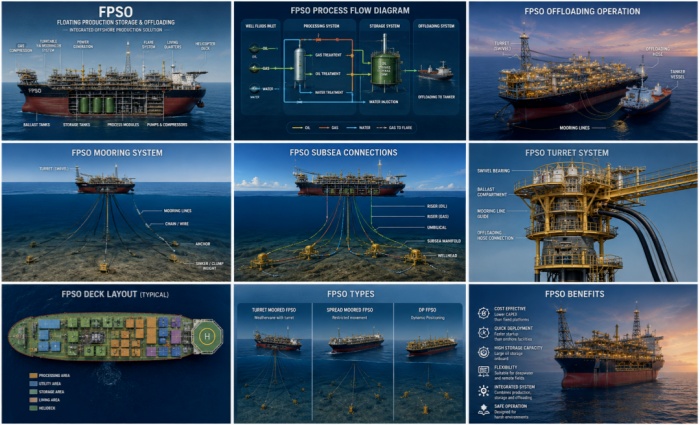
How are the oil and gas from the seabed transported to the FPSO? From the seabed wellhead to the offshore facility, understanding an invisible production line
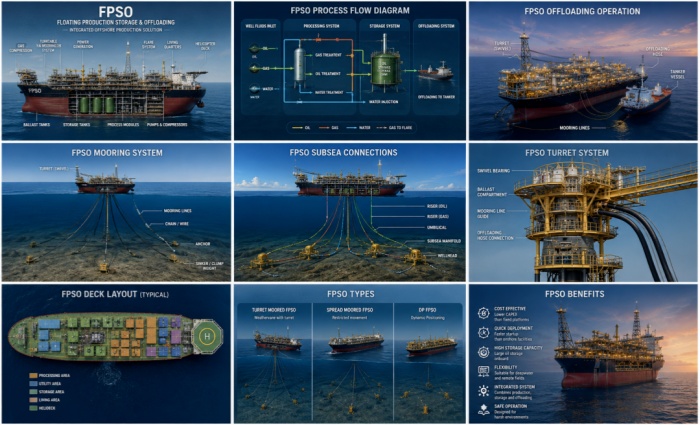
How are the oil and gas from the seabed transported to the FPSO? From the seabed wellhead to the offshore facility, understanding an invisible production line
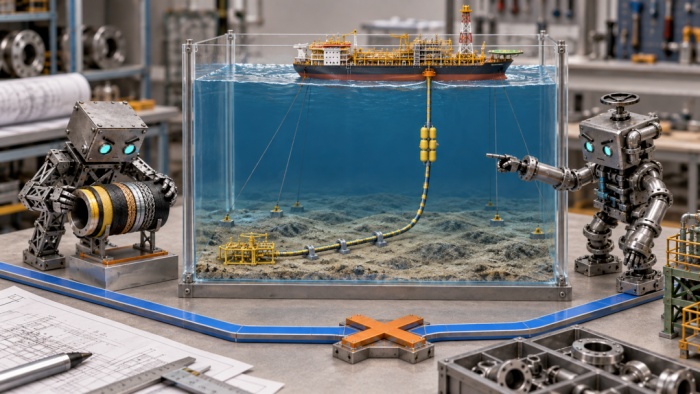
From the underwater wellhead to the offshore facility, understand an invisible production line. A FPSO is moored on the sea surface, with numerous equipment on the deck and storage space inside the hull. But have you ever wondered: where does the oil and gas it processes come from? It's not as simple as just inserting a "sucker pipe" from the bottom of the ship to suck up the oil from the seabed. The true starting point is the reservoir layer beneath the seabed; the true passage is a production system that passes through the wellbore, spreads on the seabed, and extends to the surface. We once started from a steel plate and then moved on to the FPSO hull, and then to the offshore facility. This time, let the steel workers turn the model beneath the sea surface and walk along the route of the oil and gas once again.
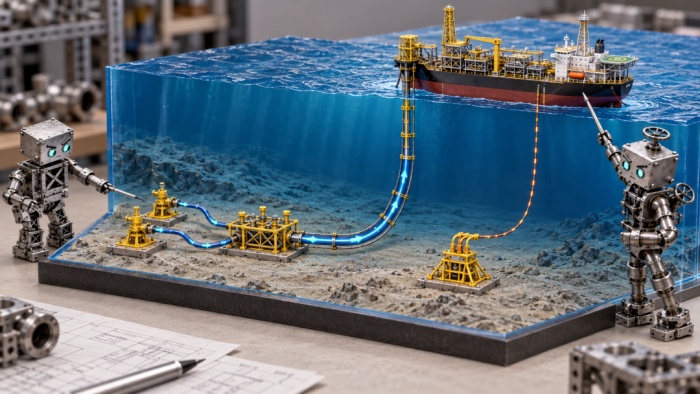
The visible yellow equipment on the seabed is not an "underground oil tank" filled with crude oil. Oil and gas usually exist in the pores of the rock layers beneath the seabed, and drilling establishes the passage, while the completion system makes this passage capable of controlled production. What reaches the seabed wellhead is not necessarily pure crude oil. As the conditions of the oil reservoir and the production stage change, the output may include oil, gas, water, and solid impurities that need to be managed. Therefore, the first thing the seabed production system faces is not "moving a barrel of oil onto the ship", but ensuring that the pressurized, temperature-controlled, and different-phase well flow runs stably along the designed path. This article follows the typical scheme of connecting the FPSO to the seabed well. The number, distance, water depth, and development method of wells vary in different oil fields, and the equipment combination and connection sequence will also be adjusted. Not every well must pass through the same manifold.
02 Production Tree: The First Production Gatekeeper at the Wellhead
The seabed production tree, called Subsea Christmas Tree in English. The name sounds like a festive decoration, but the work is very serious: through valves, throttling, and related monitoring functions, it controls and isolates the well flow. The wellhead and the production tree are not the same thing. Let's make a simple distinction for easier understanding: The wellhead provides the important pressure-bearing and connection foundation at the top of the wellbore, while the production tree assumes the production control task in the corresponding completion configuration. The production tree is not a pump that pumps the oil upwards. It is more like a production checkpoint with monitoring and isolation capabilities. The steel workers point to the valves beside the model: What matters is not "whether it is opened or not", but whether it is in the required state, whether it can be confirmed, and whether it can perform protection actions as per the design in case of an anomaly.
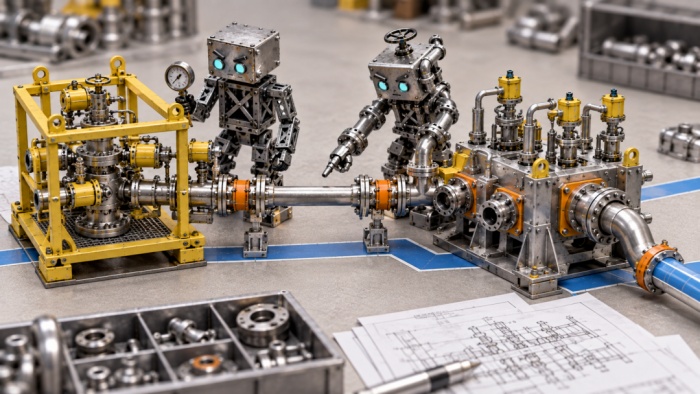
From the outlet of the production tree to adjacent facilities, one can often see a cross-connection pipe called Jumper. It can adopt a rigid or flexible scheme to complete local connections between equipment. This connection seems short, but it needs to align with the actual interface position and direction, and meet pressure, temperature, load, and installation requirements. There is no room for "just bending it on the spot" on the seabed. The output of multiple wells can be collected at the manifold - Manifold - and then sent to the subsequent production pipelines. Understanding it as a gathering node with valves and branches is more accurate than regarding it as "an offshore oil refinery". The ordinary production manifold is responsible for collecting and routing, and should not be assumed to be a processing device that has already completed the separation of oil, gas, and water. If a development scheme uses equipment for seabed separation and pressurization, it is an additional system function that needs to be explained separately and cannot be concluded based on a yellow frame photo.
04 Subsea Pipelines: Connecting is just the beginning, stable flow is the goal
After leaving the wellhead or manifold, the well flow moves along the Flowline, which is the production flow path, towards the receiving facility. It may not follow a straight line: the seabed topography, existing facilities, geological conditions, and installation methods will all affect the routing. [1][2] This seemingly quiet section of submarine pipeline actually undertakes multiple tasks simultaneously, including bearing pressure, resisting corrosion, adapting to temperature changes, and coping with seabed support conditions. The interior of the pipe is not just a row of "oil molecule teams" marching in unison. Gases and liquids may exhibit different flow patterns under different operating conditions; certain segments under certain conditions may cause significant fluctuations for downstream receiving equipment. [3] The steelmen of the pipeline system are concerned about every joint, while the structural steelmen are concerned about every support. Because the pipeline is not only a flow channel but also a long-term stressed engineering structure.
05 How can oil and gas come up? Don't just look at how deep the sea is
"Underwater so deep, how do we send oil and gas to the surface?" The key lies in the pressure and energy conditions of the entire production system: the driving force provided by the reservoir, the pressure drop of the wellbore, pipeline and riser, and the conditions required at the receiving end. These must be analyzed together. Some development stages can rely on sufficient reservoir energy for production; some plans require artificial lifting, submarine boosting or other measures. As production progresses, these requirements may also change. [3] Therefore, "all FPSOs rely on submarine pumps to extract oil" and "with reservoir pressure, there is no need for boosting at all" both oversimplify the complex issue.
06 The most difficult blockage points, sometimes invisible
Warm well flow entering the cold seabed environment will undergo heat exchange with the surroundings. Under specific pressure, temperature and component conditions, there may be a risk of hydrates; wax and other sediments may also limit flow. Not all oil fields face these problems simultaneously. [3] This is Flow Assurance - flow protection - the questions that need to be answered: Can the fluid maintain a manageable state along the system from start-up, normal production to shutdown and restart? Insulation, heat management, chemical agents, pressure management and operation strategies may all be part of the plan, but not by simply stacking these measures. The selection must be based on the analysis of actual fluids, environments and conditions. [3] No on-site handling steps are provided here. Abnormalities in submarine pipelines must follow the project-approved procedures and be handled by a qualified team.
07 Riser: One end in the seabed, one end connected to a moving vessel
When the production route extends from the seabed to the surface, it enters the Riser - the riser - this critical stage. The difficulty is not just "transporting vertically". There is a difference in movement between the seabed facilities and the surface floating body, and the riser needs to meet corresponding load, displacement and fatigue requirements while conducting pressure transmission. The riser can adopt different technical solutions, and they cannot all be understood as ordinary hoses. Flexible pipes are not just rubber hoses; they are engineering products composed of layers with different functions. Certain waveform arrangements use buoyancy modules to change the sagging form, but not all FPSOs adopt the same arrangement. [4]
Near the production pipeline, there might be another structure that looks like a "pipe": Umbilical, or the umbilical cable. It performs different tasks from the main production channel. According to the system configuration, the umbilical cable can integrate power, communication, hydraulic, and chemical injection channels to provide control and support for the subsea equipment, while the monitoring data is returned via the communication link. [1][2] It is helpful to think of it as the "neural and support channel" between the surface and the seabed, but do not mistake the analogy for a structural diagram: cables, optical fibers, and small-diameter pipelines each have their own responsibilities, and it is not the same cavity transmitting everything. The electrical steelmen check the power connections, and the instrument steelmen verify the signal paths. The main production pipeline is responsible for the flow of the well, while the control network is responsible for making the operations and status manageable.
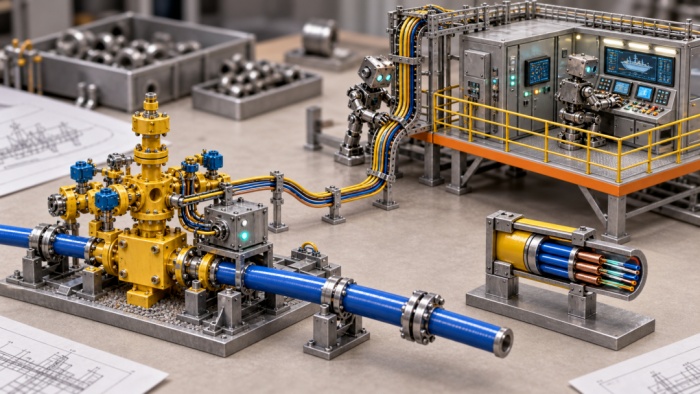
SCM, or Subsea Control Module, is an important component of the production control system. It participates in processing control signals under the corresponding system configuration and cooperates with functions such as valve operation and status monitoring. [1] When an instruction is issued from the control room, it involves power supply, communication, actuators, and feedback, and the screen status does not mean that the entire link can be ignored. In abnormal situations, what to shut down, how to isolate, and how to interact with the surface system must be defined and verified in the engineering design. Some schemes will also set up a dedicated high-integrity pressure protection system, but it should not be regarded as a standard configuration for every subsea development project.
10 From model to reality: Before the connection, there is another subsea construction
These devices do not appear neatly on the seabed on their own. The engineering team needs to complete the corresponding surveys, designs, manufacturing, and tests, and then organize transportation, lowering, laying, and connection. The installation sequence of different equipment depends on the project plan and offshore operation arrangements, and should not be understood as the only construction sequence. In deep-water operations, ROV - Remote Operated Vehicle - is an important tool that can participate in observation, inspection, and applicable operation tasks. Whether it can approach the interface, whether it can see the target clearly, and whether the tool can enter are all issues that need to be considered in the design stage. This also explains why a small connection port can involve many professionals: manufacturing dimensions, seabed location, installation tools, sealing and test requirements, and ultimately must be coordinated at the same interface.
11 The oil and gas finally reach the ship, but not yet to the storage tank
After the well flow reaches the FPSO, it first enters the corresponding receiving and processing system, rather than directly filling the storage space of the ship body. Topside, this offshore factory takes over the next step: completing separation and processing according to the process plan. Oil, gas, and water then enter their respective processing and destination paths; only the crude oil that meets the requirements enters the storage and subsequent external transportation process. The gas may be used for fuel, external transportation, or reinjection, depending on the project design. The subsea system is responsible for safely and stably delivering the output to the receiving end, while Topside needs to be able to catch this well flow. The inlet conditions and processing capacity cannot contradict each other.
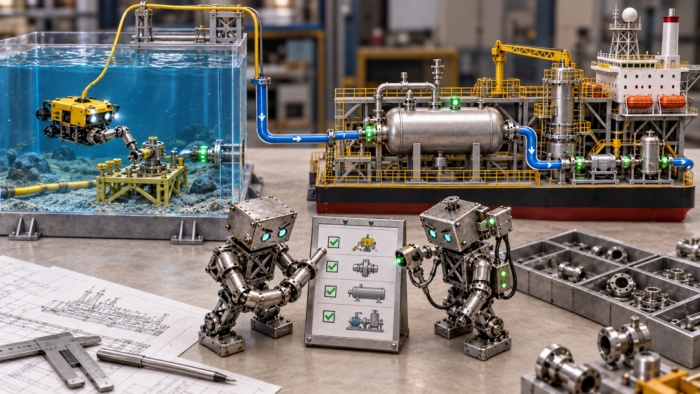
The lowering of the working equipment, the connection of the pipelines, and the presence of images on the ship are only part of the completion conditions. The project also needs to verify the installation integrity, connection and sealing status, cleanliness status, control and protection functions within the prescribed boundaries, and prepare for the corresponding commissioning, startup and operation stages. The scope and acceptance conditions of each task should be based on the project documents. After commissioning, the system still needs to monitor, inspect, manage integrity, and make necessary interventions. Subsea equipment is difficult to directly approach, making the quality management in the early stage and the subsequent status management particularly important.
Conclusion: On the surface of the sea is a ship, and beneath the sea is an engineering network.
Standing on the deck, you can see the pipes, equipment and torches, but you cannot see the valves, connectors and production pipelines on the distant seabed. However, whether this factory can stably receive raw materials depends precisely on those invisible connections. The oil production well guards the production gate, the cross接管 completes the local connection, the manifold organizes the flow, the submarine pipeline undertakes the transportation, the riser crosses the movement boundary, the umbilical cable and the control system enable the entire network to have the ability to be managed. The oil and gas from the seabed to the FPSO is not the story of "just one pipe", but a complete system that connects their respective boundaries together. In the next article, we will shift our focus back to the deck: After the crude oil is loaded onto the ship, how does it gradually turn into a product that can be stored and exported?